Ring, known for its doorbell cameras, launches a home security drone and an enterprise security robot

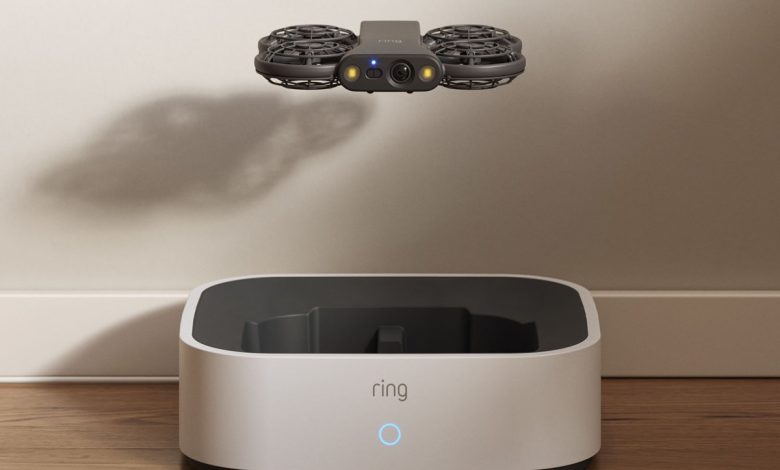
Ring, the Amazon-owned home security company, is launching its own robotics division, with an eye toward automating security at both the home and the office. The company announced Ring Robotics on Tuesday, debuting two new devices that are sure to stir more than a little bit of controversy.
The first new device is a home security drone that users will be able to deploy to patrol their domiciles when they’re out. The other item that the company is launching is a roving enterprise security robot, designed for businesses.
First, the drone. Ring calls the device a “flying indoor security camera” — which should give you a pretty good idea of what it’s supposed to do and how it’s supposed to work. Ring Drone Cam is designed to fly from room to room, inspecting what is happening in a user’s house and, if there’s trouble, to alert them. It has been built to integrate with Ring’s other home security devices, so, for instance, if a Ring alarm goes off in a particular part of the home (say, the back door), the bot will supposedly fly to that location and investigate. When it’s not in use, the drone stays inactive in a docking bay.
The drone shoots video in 2K and it also comes equipped with LED lights so that it can keep watch at night and record video in low light. It can be controlled via Amazon’s Alexa Home Map, and the bot can also be scheduled to patrol the house at specific times — so, if you know you’re going to be out for the night or even on vacation, the drone can keep you apprised of what’s happening while you’re away.
Now let’s turn to Ring Rover Cam. Like the drone, this roving robot can be set to patrol specific routes, at specific times, within the user’s business. The robot streams video in continuous 4K, which is viewable via Ring’s mobile app, and a trigger can be set to automatically record if it detects a human. It also comes with a periscope camera, which can be adjusted to see over specific obstacles, and it includes two-way audio — meaning that, should the remote user need to communicate with a person at the store (be that an employee or a burglar), they can speak to them through the robot.
Ring says that both devices are powered by the same proprietary AI system, known as AI Pilot. The company says this system leverages “specialized vision models, sensors, and cloud processing to see, think, and navigate autonomously.” Both devices, using this software, are designed to develop a detailed schematic of your house or office purely by exploring the space for themselves, the company says.
“Together, it’s like having a guard on patrol who never clocks out,” the company claims of its new devices. “Ring Rover can do a sweep of the floor after close and investigate when sensor trips at 2 a.m. — streaming it all to your phone, wherever you are.”
Automated security is one space the tech industry has never quite cracked. In 2021, Amazon launched its own home security robot, known as Astro. Astro, which resembles Ring’s new robot (the company says that it was inspired to create the bot because of “feedback from Amazon Astro customers”), was first announced as a kind of nebulous domestic helper before being repurposed as an enterprise security product. The device never took off, however, and seven months into the robot’s glow-up as a small business security guard, Amazon put the device out to pasture.
Privacy concerns have long dogged Ring — with critics frequently alleging that the company’s cameras have created unofficial surveillance networks that police departments can (and routinely do) tap into. It seems natural to assume that similar complaints will be lodged about the company’s newest products, given the invasive potential of both.
However, Ring claims that both devices have been built with “privacy and security” baked into them. The company notes that the videos recorded by both devices are protected by TAKE (Throw Away the Key Encryption), which the company calls its “strongest default encryption yet.” It’s unclear whether there will be an option for local video storage. Ring cameras generally record their videos to the cloud.
The Rover is being made available starting on December 16, and it will retail at a whopping $1,000.The drone, meanwhile, won’t launch until next year, on January 27, and will be made available for $270.
-Tech Crunch